Chapter Three — The Kitchen
From the Kitchen: Cooking Breakfast at 6,000 Feet
How a mountain cafe kitchen actually works — the compressed breakfast rush, steam-scrambled eggs, the burrito as engineering, and why altitude changes every timing on the line.
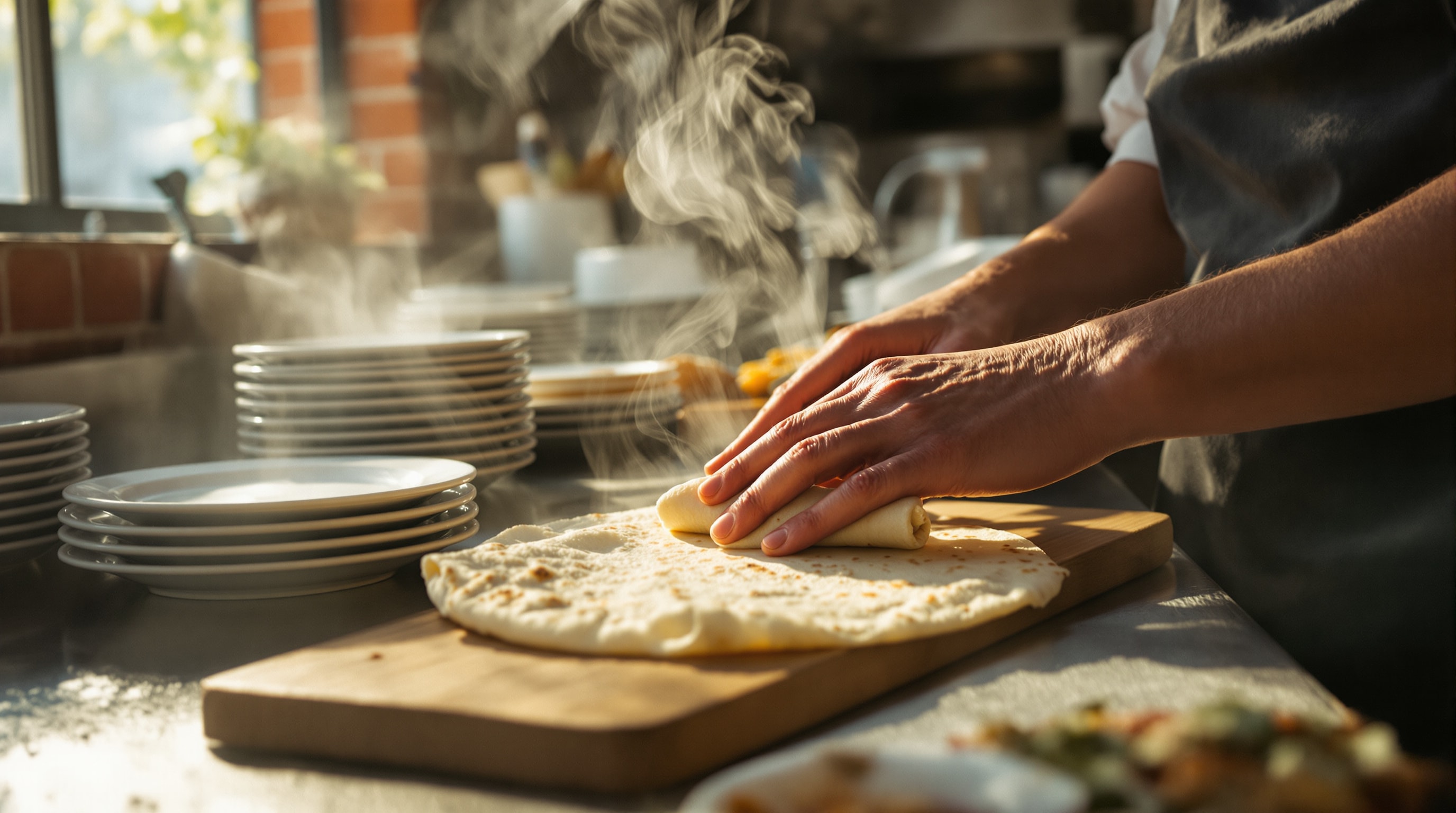
The hot line in a mountain café is one of the strangest kitchens in food service. It runs at full sprint for roughly three hours, serves a room in which half the customers are wearing technical outerwear and the other half are working, and then goes quiet for the rest of the day. Everything about how it is designed follows from that shape. This page describes the craft — it is not anyone's menu.
The Rush Is Short and Absolutely Vertical
In a resort valley, breakfast is not a service period. It is a spike. Lifts spin mid-morning, trailheads empty out early in summer, school starts around eight, and construction crews are on site before seven. The result is that a café kitchen can do sixty per cent of its day's covers in the ninety minutes either side of eight in the morning.
A restaurant kitchen absorbs that with staff. A café kitchen — one cook, sometimes two, in a space the size of a large bathroom — absorbs it with method. Almost every distinctive technique on a mountain breakfast line exists to move that spike faster.
Steam-Scrambled Eggs, and Why They Exist
The signature technique of the American café kitchen is scrambling eggs with the espresso machine's steam wand: raw egg into a steaming pitcher, wand in, thirty to forty seconds, done. Nothing about it is a shortcut for its own sake.
- It is fast. A pan takes three to four minutes and a burner. The wand takes well under a minute and uses equipment already running.
- It is consistent. Steam delivers even, moist heat, so the eggs set as a soft custard rather than browning at the edges.
- It saves range space. In a kitchen with four burners, freeing one during the spike is worth a great deal.
- It works at altitude. Lower atmospheric pressure means water boils cooler, so pan cooking is slower and drier than it would be at sea level. Pressurised steam sidesteps the problem entirely.
The trade-off is texture: steam-scrambled eggs are softer and wetter than pan eggs, which some people love and some people do not. Ordering them pan-cooked is normal and nobody will be offended, but expect to wait.
The Breakfast Burrito as an Engineering Solution
The burrito is not a regional affectation in mountain towns; it is the correct answer to a set of constraints. It is portable, so it can be eaten on a chairlift. It is dense in calories, which matters when the customer is about to do four thousand vertical feet. It holds heat for twenty minutes because the tortilla insulates it. It can be assembled from components already prepped, so it costs the line almost no time during the spike. And it accepts nearly any filling, which means one prep list serves a dozen menu items.
The engineering detail that separates a good one from a bad one is moisture management. Beans, salsa and eggs all release water; a burrito assembled wet turns to paste in ten minutes. Kitchens that get it right drain their beans hard, keep salsa on the side or in a controlled quantity, and build the tortilla with a dry layer — cheese or a starch — against the wrap.
What Altitude Actually Does to a Savoury Line
Above about 3,000 feet, and unmistakably by 6,000, the physics of the kitchen shift:
- Water boils cooler. Roughly 199°F at 6,000 feet instead of 212°F. Anything simmered, poached or blanched cooks more slowly, and “bring to a boil for two minutes” is no longer a sterilisation instruction.
- Evaporation is faster. Low humidity and low pressure pull moisture out of everything. Sauces reduce faster than the recipe says, and cooked food dries on the pass.
- Poached eggs behave differently. Cooler water means longer poaching and a greater tendency for whites to feather. Mountain cooks compensate with more acid in the water and fresher eggs.
- Seasoning has to be pushed. Dehydration blunts taste perception, and most customers at altitude are mildly dehydrated most of the time. Mountain kitchens salt and acidify a little harder than sea-level ones, deliberately.
The Colorado State University Extension work on high-altitude food preparation remains the standard public reference for the underlying numbers, and the USDA's food safety guidance is the one to check before assuming a boil-time instruction still holds up here.
The Shape of a Mountain Breakfast Board
Independent café kitchens across the mountain West converge on a remarkably similar repertoire, because the same constraints produce the same answers:
- Egg scrambles and sandwiches — the fast core, assembled from prepped components.
- Burritos, in several builds — vegetarian, meat, and one absurd one.
- Hot cereal — steel-cut or rolled oats, often finished with steamed milk from the same wand, because it holds indefinitely and costs almost nothing.
- Granola with yogurt and fruit — the entirely prep-side item that requires zero line time.
- Toast platform items — avocado toast, bagels, the sweet cinnamon version. A toaster is not a burner.
- A protein-forward option — cottage cheese, turkey, egg whites, aimed squarely at the athlete half of the room.
Lunch, Where There Is One
Café lunch is deliberately cold-side dominated: sandwiches, wraps, quesadillas, grain salads and one hot soup. The reasoning is the same as breakfast in reverse — by noon the single cook is also prepping tomorrow, so anything requiring live cooking has to be either a pan item or nothing. A quesadilla and a soup satisfy the entire hot-lunch demand of a mountain café with one flat-top and one pot.
The soup is the tell. A soup that changes daily and is genuinely made in house means there is a real cook doing real prep. In high-desert and mountain kitchens across the West that soup is very often a spiced tomato-and-tortilla broth, for the same reason burritos win breakfast: it is cheap, it holds all day, it reheats without degrading, and it is warming out of proportion to its cost.
Sourcing, Briefly
Mountain café kitchens are structurally local because their supply chains are long. A truck from the nearest distribution hub may run twice a week in winter and can be stopped outright by a pass closure, so kitchens keep short menus, deep dry stores and relationships with whatever bakery, dairy or ranch is inside a two-hour drive. Idaho's agricultural extension service publishes ongoing work on regional food systems through University of Idaho Extension, which is a useful window into what actually grows and gets processed within range of a valley kitchen.
For the other half of the food board — the overnight side — see the bakery case. For how the kitchen's hours fit the town's day, see Locations & Hours.