Chapter Nine — The Room
A Short History of the Mountain-Town Coffee House
How the ski-town coffee house became the public square of the mountain West — from 17th-century penny universities to the espresso bars that opened in Idaho's valleys in the early 1990s.
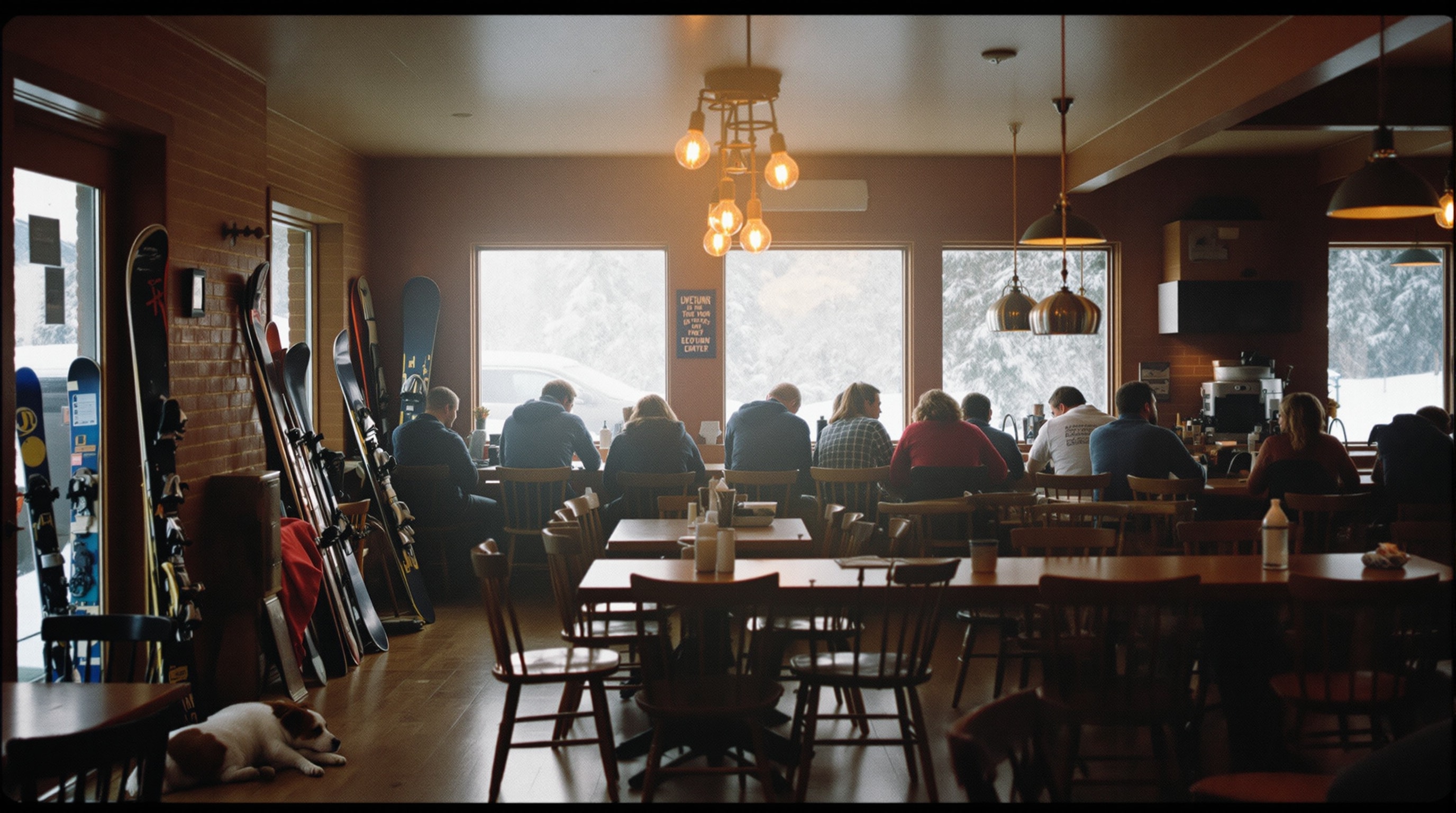
The coffee house has been a political institution for four hundred years and a mountain-town institution for about thirty-five. The second fact is a local expression of the first, and understanding the older tradition explains a great deal about why the room at the top of a valley works the way it does.
The Penny Universities
Coffee houses reached England in the mid-1600s and became something no tavern had been: a place where a man of any rank could buy admission to a conversation for the price of a cup. They were nicknamed penny universities because a penny bought entry and the talk was the education. They functioned as newsrooms, commodity exchanges, scientific societies and political clubs — London's marine insurance market grew out of one of them, and so did more than one learned society.
What made them work was a specific social contract: no reserved seating, no obligation to leave, conversation with strangers assumed rather than intruded. Governments understood the threat clearly enough that Charles II attempted to suppress them in 1675 and was forced to back down within days. The Encyclopaedia Britannica entry on the coffeehouse covers the period well, and the Library of Congress holds substantial primary material on the American descendants of the tradition.
The American Reinvention, Twice
America built its own version twice. The first was the mid-century urban coffee house of Greenwich Village and North Beach: espresso machines imported from Italy, folk music, poetry, and a clientele defined largely by not being at a bar. The second, beginning in the Pacific Northwest in the 1970s and 80s, was about the coffee itself — imported Italian equipment, dark-roasted beans, and the espresso drink vocabulary that is now universal.
The second wave travelled inland along a specific route: from Seattle and Portland east across the Cascades and into the mountain towns of Idaho, Montana, Wyoming and Colorado. It arrived in resort valleys well before it reached the cities of the interior, for a reason that is easy to miss.
Why Ski Towns Got There First
Mountain resort towns had four things that inland cities did not have until much later:
- A population that had already lived somewhere else. Ski towns are full of people who moved from cities, arrived with urban expectations, and were prepared to pay for them.
- Visitors from coffee-literate places. A resort valley receives a continuous inflow of people from Seattle, San Francisco and Los Angeles, and they ask for what they had at home.
- A genuine physical need. Cold, early, high-output days create real demand for hot, calorie-dense, caffeinated drinks. The product sells itself in a way it does not in a temperate climate.
- A shortage of public indoor space. Small mountain towns have very little third space — not enough libraries, few community halls, and bars that are unsuitable at seven in the morning. A coffee house fills a vacuum.
In Idaho's Wood River Valley the first serious espresso bars opened in the early 1990s, at the head of the valley and then a year or two later in the larger town downstream. Within a season they had become what coffee houses have always become: the place where trail conditions were exchanged, where work was found, where the town argued about itself, and where anyone new went first.
The Particular Character of a Mountain Coffee House
Ski-town coffee houses developed a set of shared traits that distinguish them from their urban cousins, and nearly all of them are consequences of the setting:
- Loud music, unapologetically. Rock, punk, reggae — a deliberate rejection of the ambient-jazz register of city cafés. It reads as a signal that the room belongs to locals rather than to a hotel lobby.
- Total indifference to appearance. Ski boots, dogs, dripping outerwear, chalk dust, bike shoes. A room that flinched at any of that would be empty.
- Very early hours. Shaped entirely by the working day of a mountain town.
- Genuine class mixing. Resort valleys have severe wealth polarisation, and the coffee house is one of a very small number of places where a lift mechanic, a contractor and a second-home owner stand in the same queue.
- Extreme regular loyalty. In a town of a few thousand, the barista knows your order after a week. This produces something no city café can reproduce.
- Improvised food. The kitchen exists because the customers are hungry and there is nowhere else open at seven, not because anyone planned a restaurant.
The Bulletin Board as an Archive
One fixture deserves separate mention, because it is the part of a mountain coffee house most likely to be lost without anyone noticing. The cork board by the door — layered with ride shares, ski swaps, lost dogs, rooms for rent, band flyers and hand-drawn trail conditions — functioned for decades as the valley’s slowest and most reliable communications network.
It was also an accidental social record. A board photographed in any given February says more about who was living in a resort town, on what terms and at what rent, than most formal accounts of the same period. Much of that traffic has moved to phones, and the boards that survive are thinner than they were. A few local historical collections have begun photographing them periodically for exactly this reason, which is a sensible instinct: ephemera is only obviously valuable once it is gone.
What Changed, and What Did Not
The last twenty years brought the laptop, mobile ordering, and enormous pressure on commercial rents in resort towns — the last of which has closed more mountain coffee houses than any competitor ever did. Housing costs also hollowed out the workforce; a valley where staff cannot afford to live within thirty miles has a structural staffing problem no amount of goodwill fixes.
What did not change is the underlying function. A mountain town still needs a warm room, open before dawn, where anyone can buy an hour of belonging for the price of a cup. That is precisely what the penny universities sold in 1660. The chocolate is better now.
For how that room organises its day, see Locations & Hours; for how its year is shaped, see The Coffee Year.