Chapter Four — The Kitchen
Baked Goods: The Case, and Why Mountain Baking Is Hard
Why baking at 6,000 feet defeats sea-level recipes — leavening, liquid, oven temperature and flour — plus a plain guide to what lives in a mountain cafe pastry case.
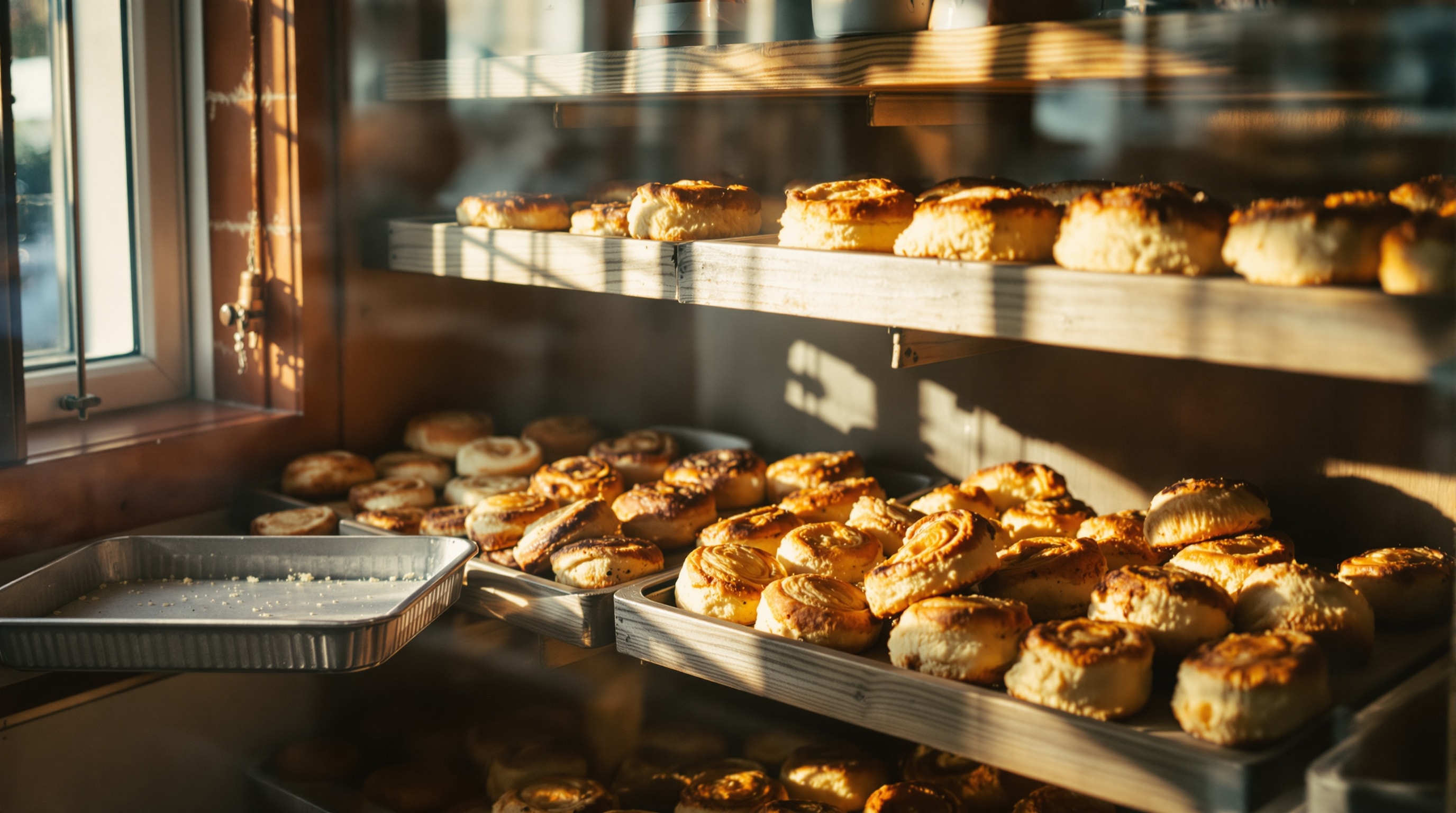
The pastry case is the part of a mountain café that most reliably separates the serious from the ordinary, because it is the part that altitude punishes hardest. Espresso can be retuned in an afternoon. A scone formula that works at 6,000 feet can take a season to arrive at. This is a guide to what is in the case and why getting it there is genuinely difficult.
The Physics, Stated Plainly
Atmospheric pressure at 6,000 feet is roughly 80 per cent of sea level. Four consequences follow, and every one of them works against the baker:
- Leavening gases expand more. The same quantity of baking powder produces a bigger, faster rise. Batters climb, over-stretch their structure before it sets, and then collapse into a crater.
- Water boils cooler and evaporates faster. Roughly 199°F at 6,000 feet. Moisture leaves the crumb early, so baked goods dry out and stale faster.
- Sugar concentrates. As water leaves faster, the remaining syrup gets stronger, which weakens the protein and starch structure exactly when it needs to hold.
- Flour is thirstier. Ambient humidity in the mountain West is low, so flour sitting in a dry storeroom absorbs more liquid than the recipe assumes.
The standard corrections — well documented by Colorado State University Extension, the reference nearly every mountain baker eventually finds — run roughly like this: cut the chemical leavening by a quarter to a third, add liquid, reduce sugar slightly, raise the oven by 15 to 25°F to set the structure sooner, and shorten the bake. Increasing the protein content of the flour also helps, because a stronger gluten network survives a more violent rise.
None of these are independent. Change the leavening and the liquid needs changing; change the oven and the timing moves. That interdependence is why a mountain bakery's recipe book is a set of local solutions, not a set of adjustments to someone else's book.
What Actually Lives in the Case
The repertoire of an American mountain café bakery is fairly stable, and each item earns its place for a reason.
Muffins
The workhorse. Muffins are batter-based, so they are quick to produce in volume, and they tolerate altitude reasonably well because they are short and squat — less structure to collapse. The classic mountain variants are berry, oat-bran, and a heavily spiced carrot-and-raisin type. Reduced-fat sour-cream formulas are a common café solution to the drying problem: the acidity tenderises and the dairy holds moisture.
Scones
The hardest thing in the case and the truest test. A scone depends on solid butter staying solid until it hits the oven, then flashing to steam and forcing the layers apart. At altitude that steam expands harder, so the window between beautifully flaky and dry, crumbling and over-risen is narrower. Savoury versions — cheese, herb, bacon — are common in mountain towns because they cross over into being lunch.
Laminated pastry and turnovers
Butter-layered doughs are demanding anywhere and worse in a dry climate, where the dough surface skins over between folds. Cafés that make their own are advertising something. Turnovers are the pragmatic compromise: laminated-adjacent, fruit-filled, forgiving.
Cinnamon rolls
Yeast-raised, and here altitude cuts the other way for once — dough proofs noticeably faster in thin air, so bakers pull back on yeast and use cold overnight fermentation. The slower cold rise also builds better flavour, which is why the best mountain cinnamon rolls are usually made by someone who shaped them the night before.
Quick breads
Pumpkin, banana, zucchini, lemon poppy seed. The rotating loaf is the baker's flexibility valve, absorbing whatever produce is turning and whatever the season suggests. It is also the most altitude-sensitive item in the case — a tall, wet batter with a long bake is exactly the geometry that sinks in the middle.
Cookies
The exception that makes everything else bearable. Cookies are flat and spread outward rather than up, so they barely notice elevation. Every mountain bakery leans on them.
The Case Is a Clock
A pastry case is the most honest object in a café. Everything in it was made in the small hours, sold until it ran out, and never restocked. That produces a set of readable signals:
- Irregular shapes and sizes mean human hands. Perfect uniformity means a frozen supplier.
- An empty shelf mid-morning is a good sign, not a bad one. It means the baker sized production to demand rather than to display.
- A rotating list means someone is deciding each night rather than executing a fixed order.
- Visible seasonality — pumpkin in October, rhubarb in June — means real produce is coming through the door.
Baking at Home Up Here
If you have moved to elevation and your baking has stopped working, the diagnosis is usually one of three things. A cake that domes then craters is over-leavened: cut the baking powder by a quarter and try again. Cookies that spread into a single sheet need less sugar and a colder dough. Bread that rises magnificently and then tastes of nothing has proofed too fast: cut the yeast by a third and retard the dough overnight in the refrigerator.
Change one variable at a time and write everything down. Mountain bakers keep notebooks for a reason. The published adjustment tables from Colorado State University Extension and the ingredient-level data in the USDA FoodData Central database will get you most of the way; the last ten per cent is your own oven.
For the hot side of the food board see From the Kitchen, and for what to drink alongside any of this, the field guide to the board.